2013-11-28
Call for action
+962 6 5822767
In determining the subsistence and infringement of copyright in musical works, courts must demarcate the work of the creator from the intellectual commons
To what extent is this demarcation justifiable?
Introduction
Law in general stands against monopolies; however, copyright law represents an exception to this principle. One of the fundamental aims of copyright is to reward the creator or owner of a particular work with commercial benefits. Several categories of works are protected under copyright law, among them the musical work, which forms the central focus of this essay.
The purpose of this study is to shed light on issues relating to the subsistence and infringement of copyright in musical works, beginning with an examination of their definition and place within the intellectual commons. It then analyses the courts’ role in demarcating the creator’s original contribution from that which belongs to the common domain. This analysis will be undertaken through a comparative assessment of two leading cases from different jurisdictions: Hyperion Records Ltd v Sawkins (United Kingdom) and EMI Songs Australia Pty Ltd v Larrikin Music Publishing Pty Ltd (Australia).
The Cases
In the Australian case, a portion of the musical notes from a song titled Kookaburra appeared within another song, Down Under. The owner of Kookaburra claimed damages for copyright infringement, whereas the defendants denied the allegation, contending that the segment copied was too brief and could instead be regarded as a tribute to Kookaburra.
In the UK case, a musician named Sawkins restored and corrected four previously unprotected music scores without adding any new musical notes. A record company, Hyperion Records, later produced a CD that included, among other pieces, Sawkins’ reconstructed works without his permission. Sawkins claimed damages on the basis that copyright subsisted in his editions, while Hyperion argued that his works lacked originality.
The Musical Work
The Australian Copyright Act 1968 provides no explicit definition of a “musical work”. Instead, it sets out provisions regarding copyright protection for musical compositions and links them to other types of works, such as dramatic or literary works. Under the Act, a musical work may be indicated or evidenced by a notated musical score or a sound recording.
Conversely, the UK Copyright, Designs and Patents Act 1988 defines a musical work as:
“A work consisting of music, exclusive of any words or action intended to be sung, spoken or performed with the music.”
However, in Hyperion v Sawkins, the court found this statutory definition unhelpful, noting that it merely categorises music, words, and actions as separate components without explaining the essence of “music” itself.
A clear understanding of the term “musical work” is fundamental, for once it is established, the court can determine the appropriate approach for assessing subsistence and infringement.
The Intellectual Commons
Copyright protection operates within a conceptual realm known as the intellectual commons, which consists of two spheres: the protected domain and the public domain. The protected domain encompasses works recognised by law—such as literary, dramatic, and musical works—as deserving of copyright protection. The public domain, on the other hand, comprises materials to which copyright no longer applies or never applied, allowing others to use them freely.
Both the UK and Australian statutes prescribe a time limit for copyright protection. Once this period expires, the work falls into the public domain and loses its legal protection. In the Australian case, the Court of Appeal confirmed an exception to this principle: a portion of a work may enter the public domain earlier if it is deemed trivial.
The Subsistence
As established, copyright protection exists within the intellectual commons but remains active only within the protected area. The judge in Hyperion v Sawkins noted that even if a work is “rubbish”, it falls within copyright protection so long as it is original.
Under the UK Copyright Act, a musical work must satisfy three conditions to attract protection: it must be (1) musical, (2) original, and (3) recorded. This highlights the pivotal role of originality in determining subsistence. The Act defines the author as the creator of the work, and to qualify as original, the creator must have exercised a sufficient degree of skill, labour, and judgment.
An idea, by itself, cannot be protected by copyright; protection arises only when that idea is expressed through the creator’s skill and effort in producing a tangible musical work. Furthermore, where an existing unprotected work is substantially improved through the exercise of skill and talent, the resulting version may qualify as a new, original work—even if no new notes are added. The determining factor is the degree of creative effort that confers originality.
In Hyperion v Sawkins, the Court of Appeal confirmed that the application of skill and effort to restore and correct old, non-protected musical compositions established new protected works. Although the 1988 Act did not explicitly address such scenarios, the court extended protection to Sawkins, thereby recognising the value of intellectual labour and interpretation in the creative process.
The Infringement
Copyright infringement presupposes the existence of a protected musical work and an act of copying, whether of the whole or a part of that work. The Australian court held that the infringement must concern a substantial part of the protected work. This requires assessing the degree of similarity between the two works—through, for instance, note-by-note comparison or by examining harmonic structure.
According to the Australian judgment, infringement occurs where an essential part of a musical work is reproduced in another composition with a perceptible level of similarity. The substantiality test focuses on the importance of the copied portion within the original work, rather than its extent within the infringing work.
Both courts agreed that infringement hinges on the qualitative significance of the copied material rather than its quantity. The UK court required that the infringing work contain an “important and quality” part of the original, while the Australian court described the test as one of quality over quantity.
Courts may rely on aural comparison or expert testimony to determine similarity—an “orthodox” approach where judges defer to musical experts for assessment. In Larrikin v EMI, expert evidence described the copied segment as a “signature” of the song. Conversely, the UK court observed that infringement may be perceptible even without detailed comparison, stating that “sounds are more important than notes”; thus, recognition of similarity by a lay listener may suffice.
Proving Originality
A distinction arises between originality in subsistence and in infringement. In Larrikin v EMI, the court held that a plaintiff need not prove originality to claim damages for infringement—it is sufficient to show that the infringed portion was substantial within a protected work. However, to establish subsistence of copyright in the first instance, originality must be proven, as affirmed in Hyperion v Sawkins. Consequently, proving originality is crucial only when the existence of copyright protection itself is challenged.
Inquiry
An important inquiry arises from these findings: what becomes of the non-essential portions of musical work? Even if such parts are not substantial, they may still embody the author’s skill and effort and therefore warrant protection under the traditional UK test of labour, skill, and judgment.
The Australian court stated that musical works should be treated as a whole when assessing subsistence, yet its omission of explicit protection for non-essential elements may imply that these fall within the public domain. This interpretation risks leaving parts of a work—though the product of creative labour—unprotected.
Conclusion
Demarcating the creator’s contribution in a musical work from the intellectual commons is essential in determining subsistence and infringement. Such judicial demarcation draws the boundary between what is protected and what belongs to the public.
In Hyperion v Sawkins, the court articulated the spirit of copyright law by recognising originality in a restored musical work without the addition of new notes, thereby rewarding intellectual labour and interpretive effort.
With respect to infringement, courts have held that copying an essential part of a protected work constitutes infringement, regardless of its prominence or intended use within the infringing piece. Thus, the proper test remains one of quality, not quantity.
In the author’s view, copyright protection should extend to cover the musical work as a whole, not merely its essential parts. Musical compositions represent integrated artistic expressions, and every creative element should be acknowledged. Nevertheless, the essential part retains particular importance in detecting acts of reproduction. Once infringement of that part is established, protection should naturally encompass the remainder of the reproduced material within the protected work.
Bibliography
Books:
Tanya Aplin and Jennifer Davis, Intellectual Property Law: Text, Cases, and Materials (2nd edn, Oxford University Press 2013).
Cases:
EMI Songs Australia Pty Ltd v Larrikin Music Publishing Pty Ltd [2011] FCAFC 47.
Hyperion Records Ltd v Sawkins [2005] EWCA Civ 565.
Journals:
Cornwall Stodart Lawyers Pty Ltd, ‘Copyright Infringement of a Musical Work: Larrikin Music Publishing Pty Ltd v EMI Songs Australia Pty Limited [2010] FCA 29’ (29 May 2010).
Jane C. Ginsburg, ‘The Concept of Authorship in Comparative Copyright Law’ (Columbia Law School, 10 January 2003).
Jane C. Ginsburg, ‘“Une chose publique”? The Author’s Domain and the Public Domain in Early British, French and US Copyright Law’ [2006].
Legislation:
Copyright Act 1968 (Australia).
Copyright, Designs and Patents Act 1988 (UK).
Seminars:
Dr Marta Iljadica, Justifications for Intellectual Property Rights I, Seminar 1, Comparative Intellectual Property Law Module, University of Southampton, 9 October 2013.
Websites:
UK Government, ‘How to Protect Your Intellectual Property’ (GOV.UK, 20 December 2013) https://www.gov.uk/intellectual-property-an-overview accessed 5 January 2014.
Attorney-at-Law
University of Southampton, 2013
In determining the subsistence and infringement of copyright in...

The Jordanian Higher Administrative Court has recently issued a...

The Administrative Court rejected the lawsuit filed by MP...

The Higher Administrative Court issued a final ruling annulling...
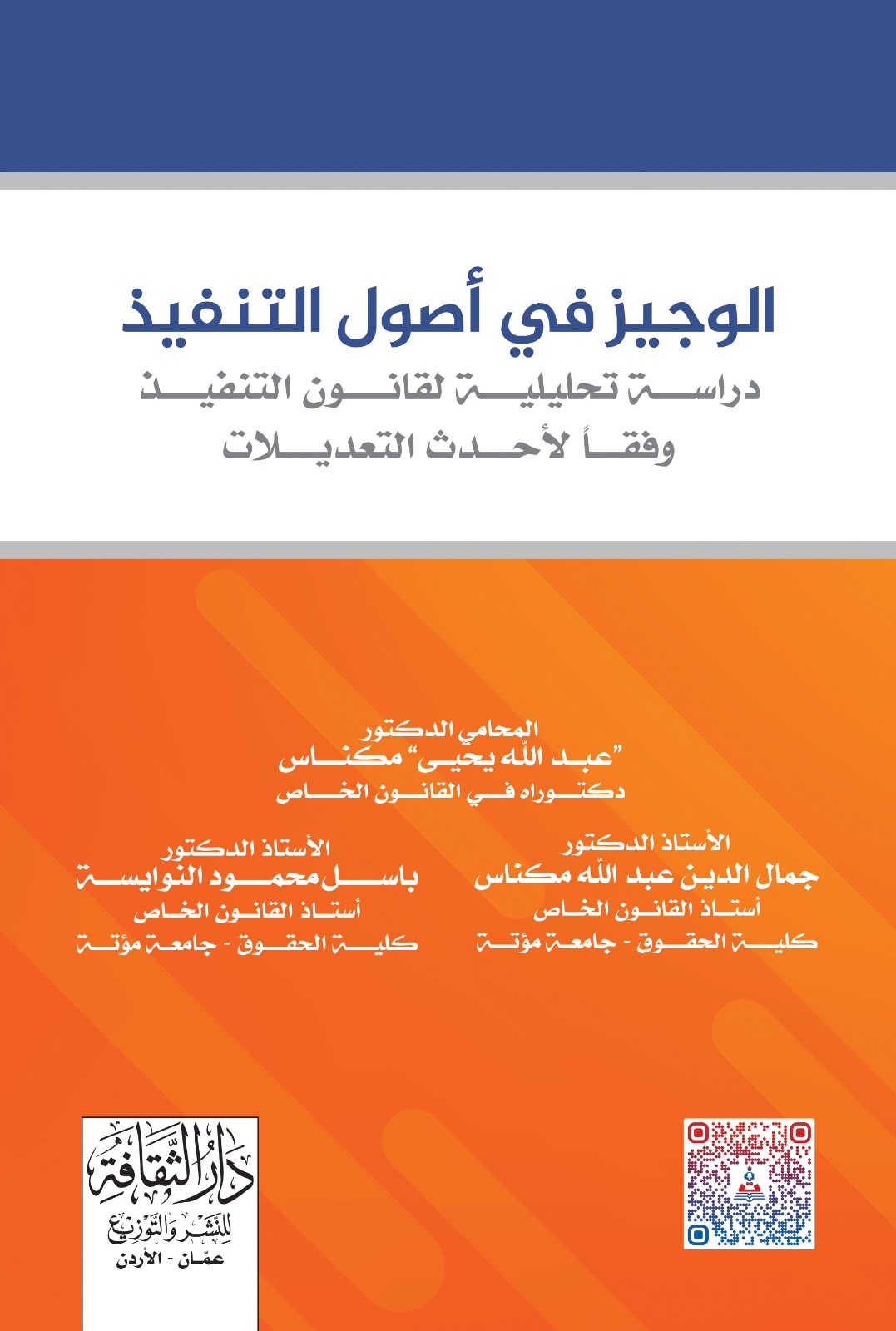
A new academic publication titled “Al-Wajeez fi Usul al-Tanfeed:...

The Higher Administrative Court issued a final ruling upholding...
المحكمة الإدارية العُليا تُلغي قرار لوزير الأشغال العامة...
Call for action
+962 6 5822767